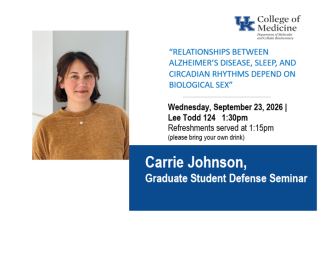
Relationships Between Alzheimer's Disease, Sleep, and Circadian Rhythms Depend on Biological Sex
Carrie Johnson, Graduate Student Defense Seminar
Date & Time: Wednesday, September 23rd, 2026 at 1:30pm
Location: Lee Todd 124
Speaker(s) / Presenter(s): Carrie Johnson
Lunar Modulation of Sleep
Dr. Horacio de la Iglesia | de la Iglesia Lab
Date & Time: Thursday, September 3rd, 2026 at 2:00pm
Location: THM 116
Speaker(s) / Presenter(s): Dr. Horacio de la Iglesia | Faculty Host: Dr. Michael Tackenberg
Abstract: Throughout evolution and history, humans have progressively isolated themselves from natural cycles through built environments that isolate them from the external environment. Key to this isolation is our ability to manipulate artificial light and extend our activity into the nighttime. Recent studies from our laboratory suggest that moonlight not only had a similar effect on activity in ancestral times, but also that the phases of the moon continue to shape our daily sleep in highly urbanized communities. I will present data from human and nonhuman primates that provide evidence for the synchronization of sleep by lunar gravity and for the mechanisms by which the moon may regulate sleep physiology.
Mechanisms Linking Circadian Misalignment and Insufficient Sleep to Poor Health
Dr. Kenneth Wright | Wright Lab
Date & Time: Thursday, October 8th, 2026 at 2:00pm
Location: THM 116
Speaker(s) / Presenter(s): Dr. Kenneth Wright | Faculty Host: Dr. Julie Pendergast
Abstract: Circadian rhythms and sleep are highly integrated systems important for healthy physiology. In modern society, exposure to less sunlight light during the day and electrical light at night disturbs sleep and circadian rhythms. Disturbed sleep and circadian rhythms contribute disease and mechanisms of disease risk include alterations in energy metabolism and in the human proteome and metabolome. This talk will briefly review the above concepts and present new findings in this area of integrative translational research.